Last Updated on 08/01/2026 by Ethan Sawyer
Choosing a college major is a huge decision, but right alongside it is another critical choice: deciding between a Bachelor of Arts (BA) or a Bachelor of Science (BS) degree. And no worries if you’ve found yourself staring at available majors and wondering, “So… what’s the difference between a BA and a BS?”—if so, you’re very much not alone.
The truth is, both degrees are valuable and lead to great careers, but they represent two distinct educational pathways (and often have different requirements and can lead to different opportunities).
Understanding their differences will help you choose the path that best supports your learning style and career goals. So below, we’ll break down the key distinctions between a BA vs a BS.
Let’s dive in.
What is a Bachelor of Arts (BA)?
A Bachelor of Arts (BA) is one of the most common types of undergraduate degrees. The BA pathway emphasizes a broad liberal arts education. While you’ll focus on a specific major (e.g. Psychology or History), the curriculum is designed to make you a well-rounded thinker, communicator, and problem-solver.
A BA degree typically requires:
-
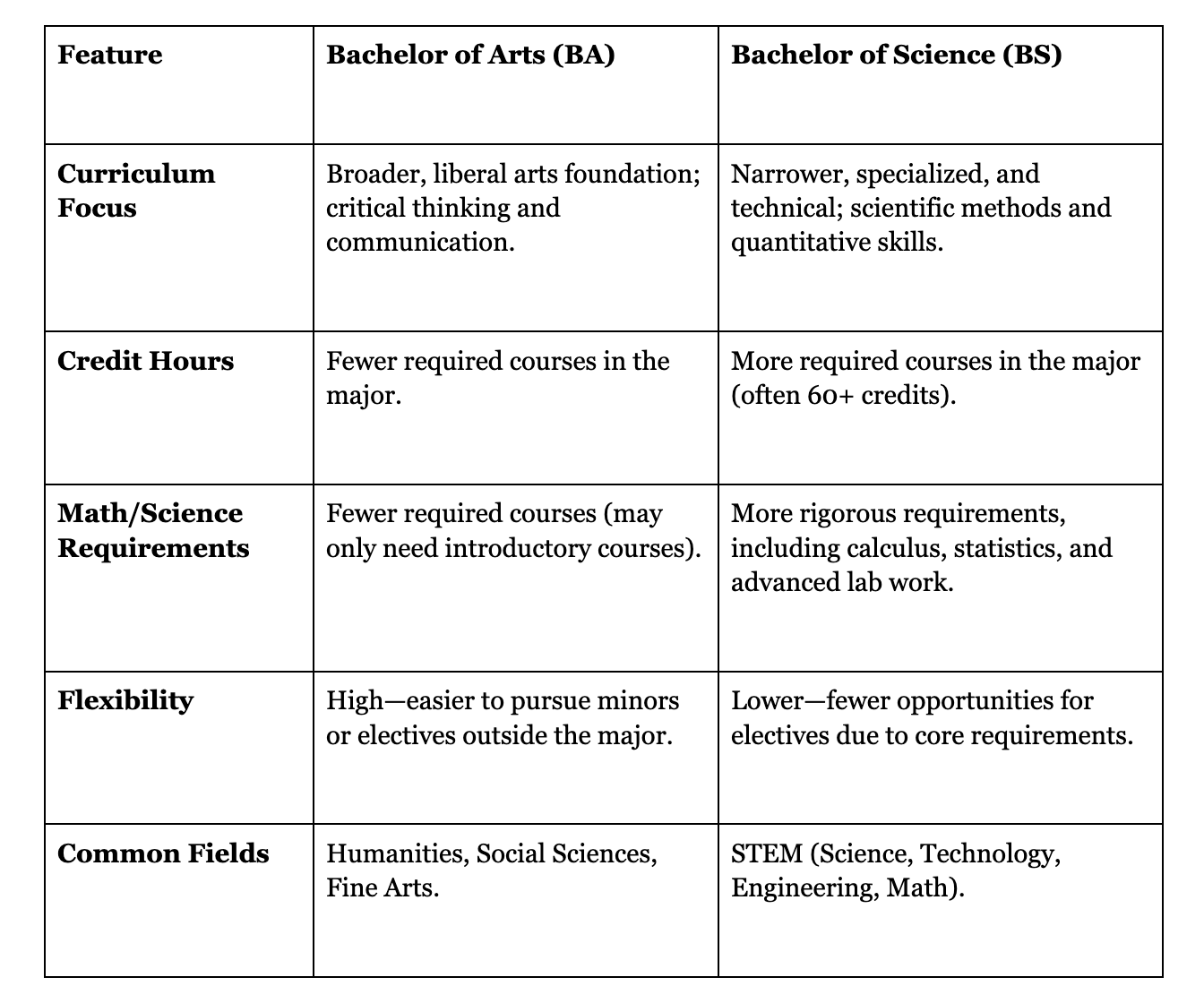
Fewer credits within your major.
-
More credits in general education requirements, which often include a second language, humanities, social sciences, and fine arts.
-
Greater flexibility to double-major or minor in different fields.
Key Takeaway: a BA is about developing strong critical thinking, writing, communication, and analytical skills that can be applied across many different industries.
What is a Bachelor of Science (BS)?
A Bachelor of Science (BS) degree, in contrast with a BA, is usually more specialized and technical. This degree is typically awarded in scientific and technical fields, and the curriculum is designed to provide you with deep, comprehensive knowledge in your chosen subject area.
A BS degree typically requires:
-
More credits focused specifically on your major.
-
Fewer general education courses, though they are still required.
-
A strong emphasis on quantitative reasoning, laboratory work, and advanced math/science coursework.
Key Takeaway: The BS path is for students who want a deep dive into the technical aspects of a discipline, preparing them for more focused roles or advanced professional/graduate studies.
Key differences: BS vs BA
The main distinction between a BS vs BA generally comes down to the focus and intensity of the curriculum within the major.
Is a BA or a BS right for me?
There’s no simple answer here (that’s probably obvious). There are just too many variables to consider, like your goals, interests, values, etc.
But you can find the right fit by asking yourself a few key questions:
-
Do you enjoy technical depth? If you love labs, advanced mathematics, and want to learn the how and why behind technical systems, a BS might be a better fit.
-
Do you want a broad education? If you’re interested in a major but also want the flexibility to take classes in things like philosophy, foreign language, or creative writing, a BA generally gives you more space for that.
-
What are your career goals? Some careers, like research science or engineering, virtually require the rigorous background of a BS. Others, like marketing, law, or journalism, value the communication and adaptability of a BA.
Another lens you can use to narrow things down is to think about what major (or majors) you’re primarily interested in, so we’ll talk about those in the next sections.
(Side note: If you want a guide on steps for how to pick a major, head here.)
Common BA majors
You’ll typically find a BA degree offered in majors like:
-
English
-
History
-
Communications
-
Foreign Languages
-
Political Science
-
Sociology
-
Art History
-
Philosophy
Common BS majors
A BS degree is most common in majors such as:
-
Engineering
-
Chemistry
-
Physics
-
Nursing
-
Computer Science
-
Finance
-
Mathematics
-
Biology (depending on the institution)
BA vs BS curriculum differences
Differences between a BA vs a BS curriculum can vary, but to really understand the BA vs BS distinction, look at the course list for the exact same major at the same university.
For example, a BA in Economics might require four math/stats courses, while the BS in Economics at the same school might require six to eight, including advanced econometrics and calculus III. The BS curriculum is simply deeper and more quantitative.
What kinds of jobs can you get with a BA?
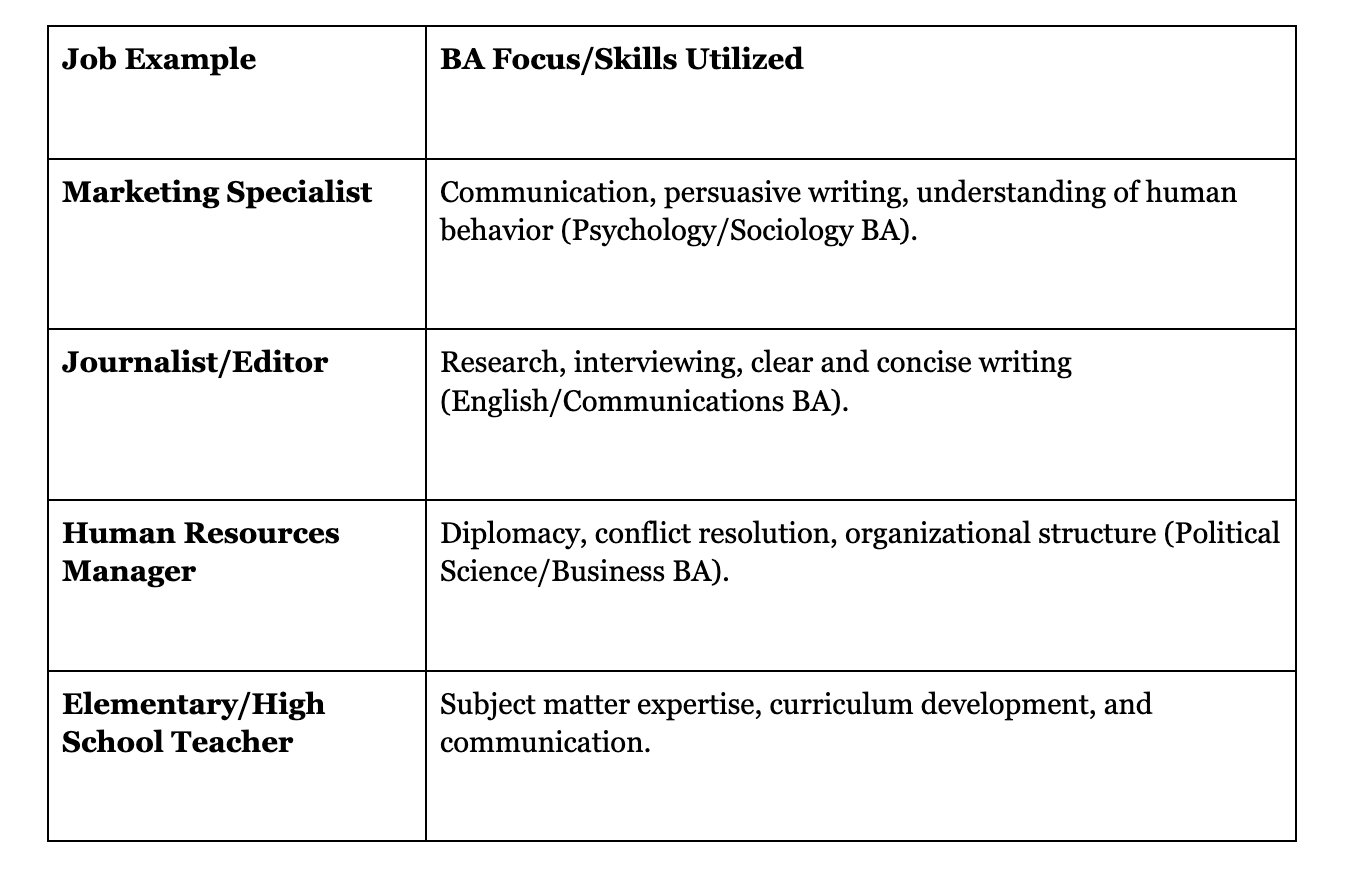
A BA degree prepares you for a pretty huge range of careers because of its focus on transferable skills as much as on knowledge base.
If you can write well, analyze a problem, and communicate clearly, you can pivot between a lot of industries. (For more on what skills employers tend to look for, check out this guide on ways majors do matter, and can also matter less than you might think in certain ways.)
You can also head to law school or business school or med school with a BA.
What kinds of jobs can you get with a BS?
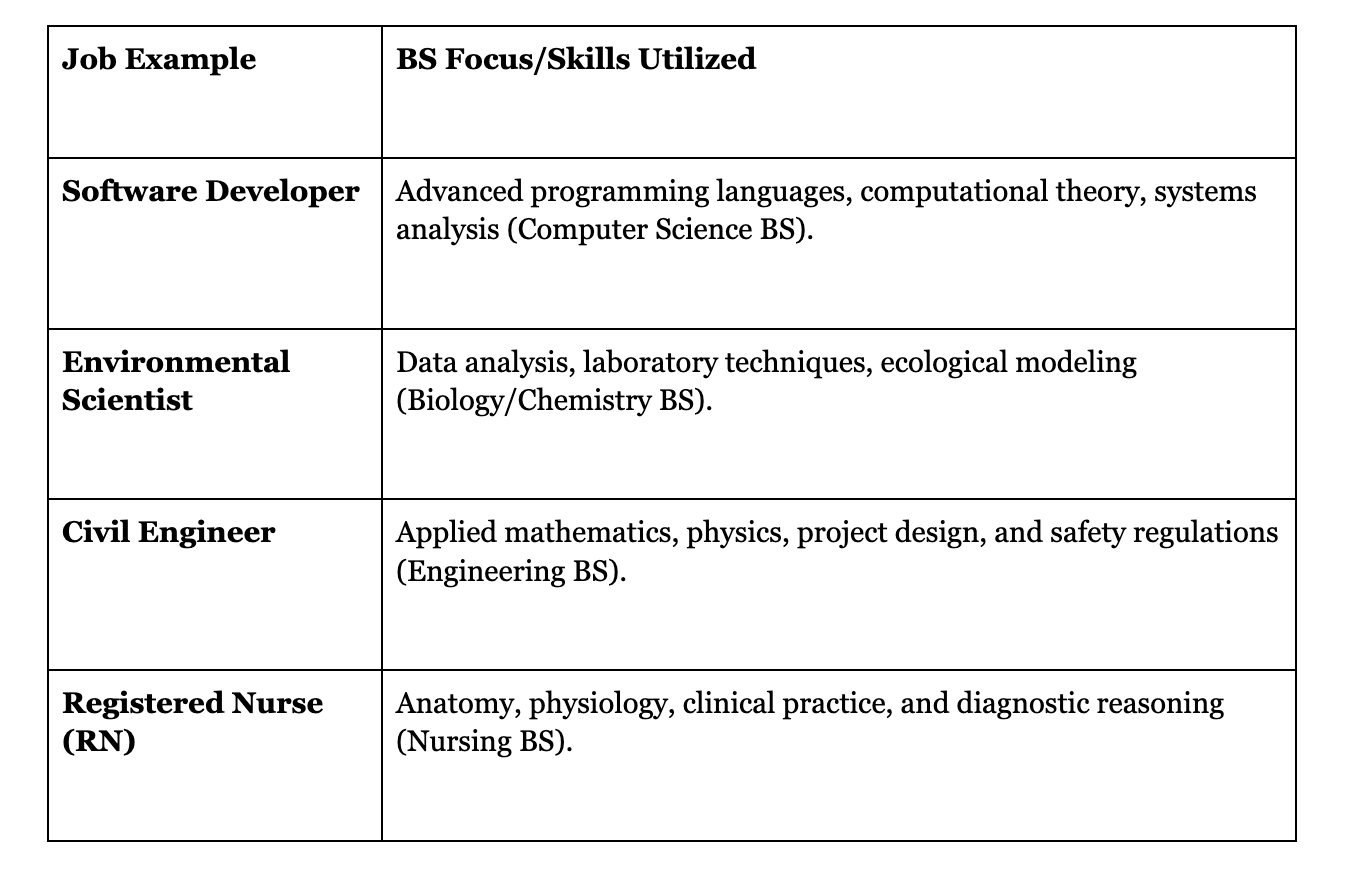
A BS degree is designed for roles that require a strong, specialized technical foundation. These roles often involve research, design, analysis, and hands-on application of scientific principles. You’re likely to be working in STEM, or something closely related.
BA vs BS in specific majors
Here’s where things tend to get confusing for a lot of students: For many popular majors, colleges offer both a BA and a BS option.
So here’s a quick breakdown of what that difference usually entails, via some specific examples:
BA vs BS in computer science
-
Computer Science BA: Often requires fewer advanced math and science courses, allowing for more focus on things like human-computer interaction, ethics in technology, or a minor in a related field like graphic design. It’s often better suited for roles like technical writing or product management.
-
Computer Science BS: Requires heavy coursework in calculus, differential equations, and advanced theory (algorithms, data structures, etc.). This path is designed for core software engineering, game development, or pursuing graduate-level research.
Psychology BA vs BS
-
Psychology BA: Focuses on the social science and liberal arts aspect of the field. You’ll take more courses in sociology, history, and the humanities. Ideal for students interested in counseling, social work, or law.
-
Psychology BS: Emphasizes experimental methods, statistical analysis, and the biological basis of behavior (neuroscience). It’s the standard path for students planning to pursue a Ph.D. in research psychology.
Biology BA vs BS
-
Biology BA: Lighter on the required lab hours and may require less chemistry and physics. This is often an ideal path for students preparing for teaching or non-research healthcare careers.
-
Biology BS: A much more intense curriculum with substantial lab requirements, organic chemistry, physics, and sometimes advanced calculus. This is the typical track for pre-med students or those aiming for research positions.
FAQ on BA vs BS degrees
Is a BA or a BS “better”?
Neither is inherently better. That question is too simplistic. Instead, think of these more as different tools for different jobs. A BS provides better preparation for careers that require highly specialized technical skills (like, say, engineering). A BA provides better preparation for careers that require adaptable, broad-based skills (like marketing or public relations). The best degree is the one that aligns with your goals.
Do employers care about BA vs BS?
Possibly, yes. It depends heavily on the field.
-
In highly technical fields (e.g., Engineering, Research Chemistry): Yes, a BS is often preferred, if not required (and it may sometimes be required), because it signals a deeper, more rigorous technical background.
-
In non-technical fields (e.g., Business, Communications): The distinction often matters very little. Employers in these areas tend to be more concerned (Often far more concerned) with your internships, portfolio, experience, and transferable skills, regardless of the degree type.
Is it harder to get a BA or BS?
The degrees are not generally compared on a scale of “difficulty,” but rather on different types of rigor.
-
A BS is typically more technically rigorous, requiring a greater number of advanced math, science, and lab hours.
-
A BA can be academically rigorous in areas like dense reading, persuasive writing, and critical theory.
The “harder” degree is the one that challenges your individual academic strengths the most. (As in, some strong STEM students may have a tougher time with some of the requirements for a BA, whereas students with more of a foundation/focus in writing and the humanities may have a trickier time with the more technical BS requirements.)
Andrew Simpson, CEG’s Editorial Director, has worked as an educator, consultant, and curriculum writer for the past 20 years, and earned degrees from Stanford in Political Science and Drama. He feels most at home on mountain tops and in oceans.
Top Values: Insight/Growth | Truth | Integrity